| Cooking fires are a leading cause of home fires. A small fire can escalate into a major emergency in seconds. Knowing how to prevent cooking fires, and how to respond safely if one occurs, can protect lives and property.
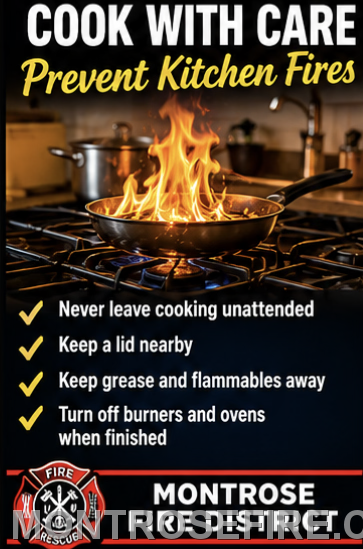
To prevent cooking fires, never leave food unattended while frying, grilling, or broiling. Keep towels, potholders, paper products, curtains, and other combustibles away from the stovetop. Turn pot handles inward to prevent accidental tipping. Keep a properly rated fire extinguisher within reach. Regularly clean cooking surfaces, ovens, and exhaust hoods to prevent grease buildup. Wear close-fitting clothing while cooking.
If a grease or cooking fire starts in a pan, do not use water to extinguish it. Water can cause burning grease to splatter, rapidly spreading the fire.
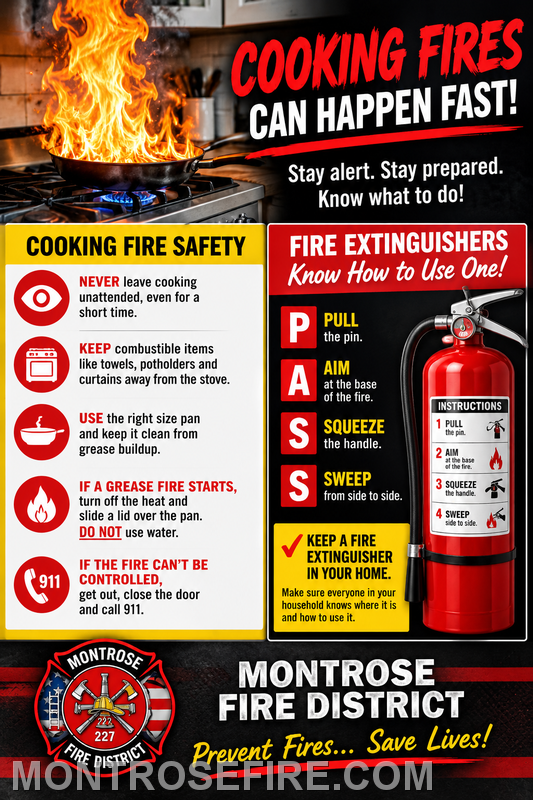
If a small grease fire starts in a pan, turn off the heat if it is safe to do so. Slide a metal lid over the pan to smother the flames, approaching from the side. Keep the lid in place until the pan is completely cool. If appropriate and available, use a Class K fire extinguisher for cooking-oil fires. Never attempt to move a burning pan or carry it outside. If the fire is spreading, cannot be safely controlled, or you are unsure what to do, evacuate immediately and call 911.
If a fire starts inside an oven, turn off the oven and keep the door closed. Do not open the door unnecessarily, as this can intensify the fire. If the fire does not go out quickly or smoke or fire escapes from the oven, evacuate and call 911.
Only use a fire extinguisher when the fire is small and contained, all occupants are evacuating, 911 has been notified or someone else is calling, you have a clear escape route behind you, and you are certain the extinguisher is appropriate for the fire.
The proper fire extinguisher technique is PASS:
- PULL the pin.
- AIM the nozzle at the base of the fire.
- SQUEEZE the handle.
- SWEEP the nozzle from side to side across the base of the fire.
If the extinguisher becomes empty and the fire is still burning, evacuate immediately. Never turn your back on a fire.
TYPES of Fire Extinguishers
Fire extinguishers are classified by the type of fire they can safely extinguish:
- Class A extinguishers: Are for ordinary combustibles such as wood, paper, cardboard, cloth, and many plastics. They are marked A.
- Class B extinguishers: Are for flammable liquids such as gasoline, oil, paint, and solvents. They are marked B.
- Class C extinguishers: Are for fires involving energized electrical equipment, including appliances, wiring, computers, and electrical panels. They are marked C. Once electrical power is safely disconnected, the fire may be reclassified based on the burning material.
- Class D extinguishers: Are for certain combustible metals like magnesium, titanium, sodium, or potassium. They are marked D and require specialized extinguishing agents.
- Class K extinguishers: Are specifically designed for fires involving cooking oils and fats, particularly in commercial kitchens. They are marked K. Class K extinguishers use a specialized agent that cools the oil and creates a barrier to prevent reignition.
- Class ABC extinguishers: Are commonly found in homes and can be used on many types of fires involving combustible materials, flammable liquids, and energized electrical equipment. However, an ABC extinguisher is not a substitute for a Class K extinguisher where a Class K unit is required. Always check the label to ensure the extinguisher is suitable for the fire you are facing.
Your first priority is always to evacuate safely. If there is any doubt about whether you can extinguish a fire safely, GET OUT, STAY OUT, and CALL 911. Never attempt to fight a fire that is spreading, producing heavy smoke, blocking your escape route, or is larger than you can safely manage.
If you have questions or concerns about fire safety, contact info@montrosefire.com. For emergencies, dial 911.
Stay tuned for the Day 6 Safety Memo.
|